Do You Really Need a Website in 2026?
Back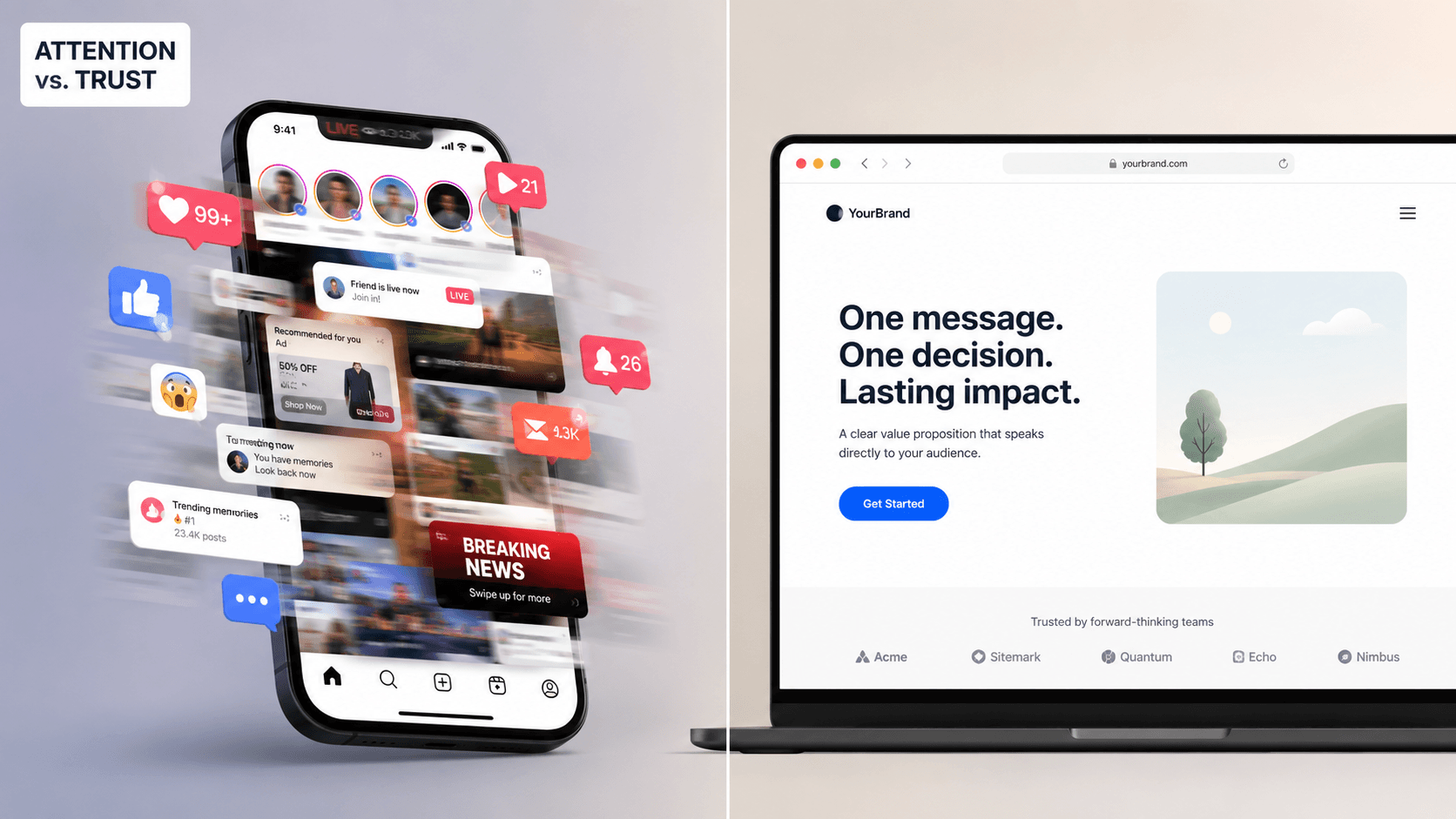
Social media brings attention, but it doesn't build trust on its own. Here's why your business still needs a website in 2026 — and what it should actually say.
If most of your customers already find you on Instagram, LinkedIn, or a WhatsApp forward, this question has probably crossed your mind. Social media is free, familiar, and it's exactly where you're already spending your time. A website, by comparison, feels like an extra project — one more thing to design, write, and maintain, for an audience that seems to be doing just fine without it.
It's a fair question to ask. It's just not the right place to stop.
The Common Argument Against Having a Website
Talk to enough founders and shop owners, and the reasoning sounds almost identical every time:
- "I get enough traffic from social media."
- "My audience already knows me — why introduce myself again?"
- "A website is just extra cost and extra maintenance."
- "People can just message me on Instagram or WhatsApp if they're interested."
None of this is wrong, exactly. Social media genuinely does bring people to your business, and your regulars probably do already know your work. But look closely at every argument on that list — each one describes people who already trust you. None of it accounts for the much larger group of people who don't know you yet, and who never will, if the only place your business exists is inside someone else's app.
The Reality: Social Media Brings Attention. A Website Builds Trust.
Social media is excellent at one thing: getting attention. A single reel can put your work in front of thousands of people who've never heard of your business before. But attention isn't the same as trust, and it's definitely not the same as a decision to buy, book, or hire you.
A website does something a social profile was never built to do:
- It explains what you do clearly, consistently, and on your own terms — not squeezed into a bio's character limit or buried three posts down.
- It works for you 24 hours a day, without an algorithm deciding who gets to see it today.
- It gives you a permanent address you actually own, instead of a rented space you're one policy change away from losing reach on.
Social media gets you noticed. A website gets you believed.
💡Tip: An algorithm decides who sees your Instagram post today. Nobody decides who sees your website — you show up whenever someone searches for exactly what you offer.
What Happens in the First Five Seconds
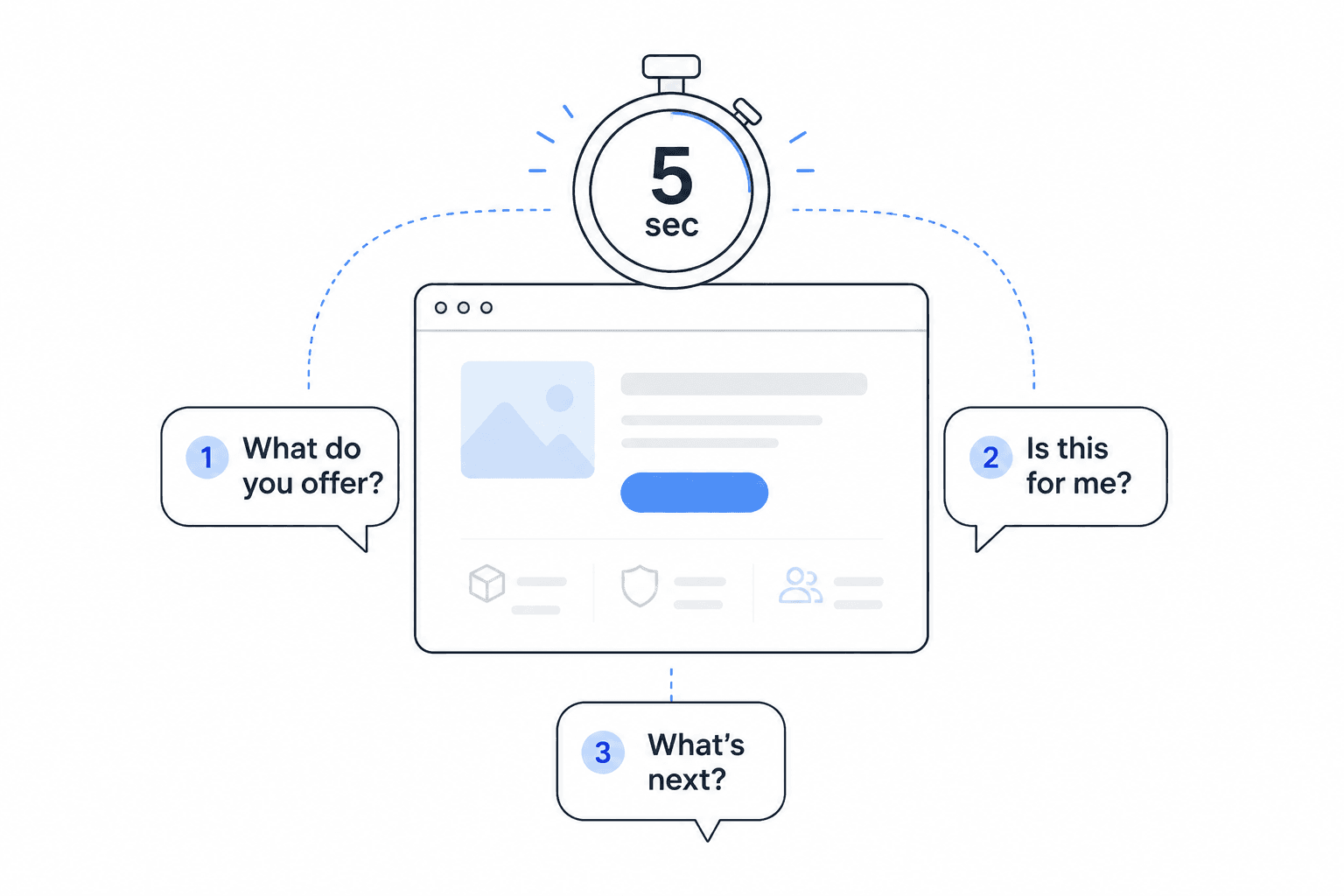
Here's the part most founders underestimate. When someone new lands on your page — whether that's a profile or a website — they're not reading. They're scanning, and almost without realizing it, they're asking three questions:
- What do you actually offer?
- Is this for someone like me?
- What do I do next?
If they can't answer those three questions within the first five seconds, they leave. And here's the part that stings a little: it's rarely because your product, your content, or your pricing is wrong. It's because people are impatient, and anything unclear reads as a reason to move on, not a reason to dig deeper.
A social media profile was never designed to answer those three questions in order. Posts are chronological, not structured — a first-time visitor might land on a two-year-old post, a giveaway announcement, or a random reel with zero context. A website, on the other hand, can be built deliberately to answer exactly those three questions the moment someone arrives.
In 2026, People Aren't Just Searching — They're Asking
There's a second, newer reason this matters more now than it did even a couple of years ago. A growing share of discovery no longer happens through a scroll or a search results page — it happens through AI assistants and chat-based search, which pull answers from structured, crawlable content on the open web.
An Instagram profile or a WhatsApp catalog isn't built to be read, indexed, or referenced that way. A website is. If your business has no website, you're not just harder to find on Google — increasingly, you're invisible to the tools people are starting to ask instead of searching manually.
ℹ️Info: This doesn't replace good SEO or social media — it adds a new channel that only exists for businesses that have a real, structured website to begin with.
Your Website Really Only Has One Job
Strip away the design trends, the animations, and the stock photography, and a good business website is doing exactly five things:
- Explain what you do — in plain language, above the fold, without making anyone guess.
- Make it clear who it's for — so the right customers recognize themselves immediately.
- Remove doubt — through real work, real numbers, and real proof, not just claims.
- Build trust — through consistency and a presence that matches the quality of what you actually deliver.
- Guide the next step — one clear action, not five competing buttons.
That's the whole job. Everything else — layout, color, animation — exists only to support those five things. A website that looks impressive but still leaves a first-time visitor unsure what you do, or what to do next, hasn't done its job, no matter how good it looks in a screenshot.
Social Media and Your Website Aren't Competing
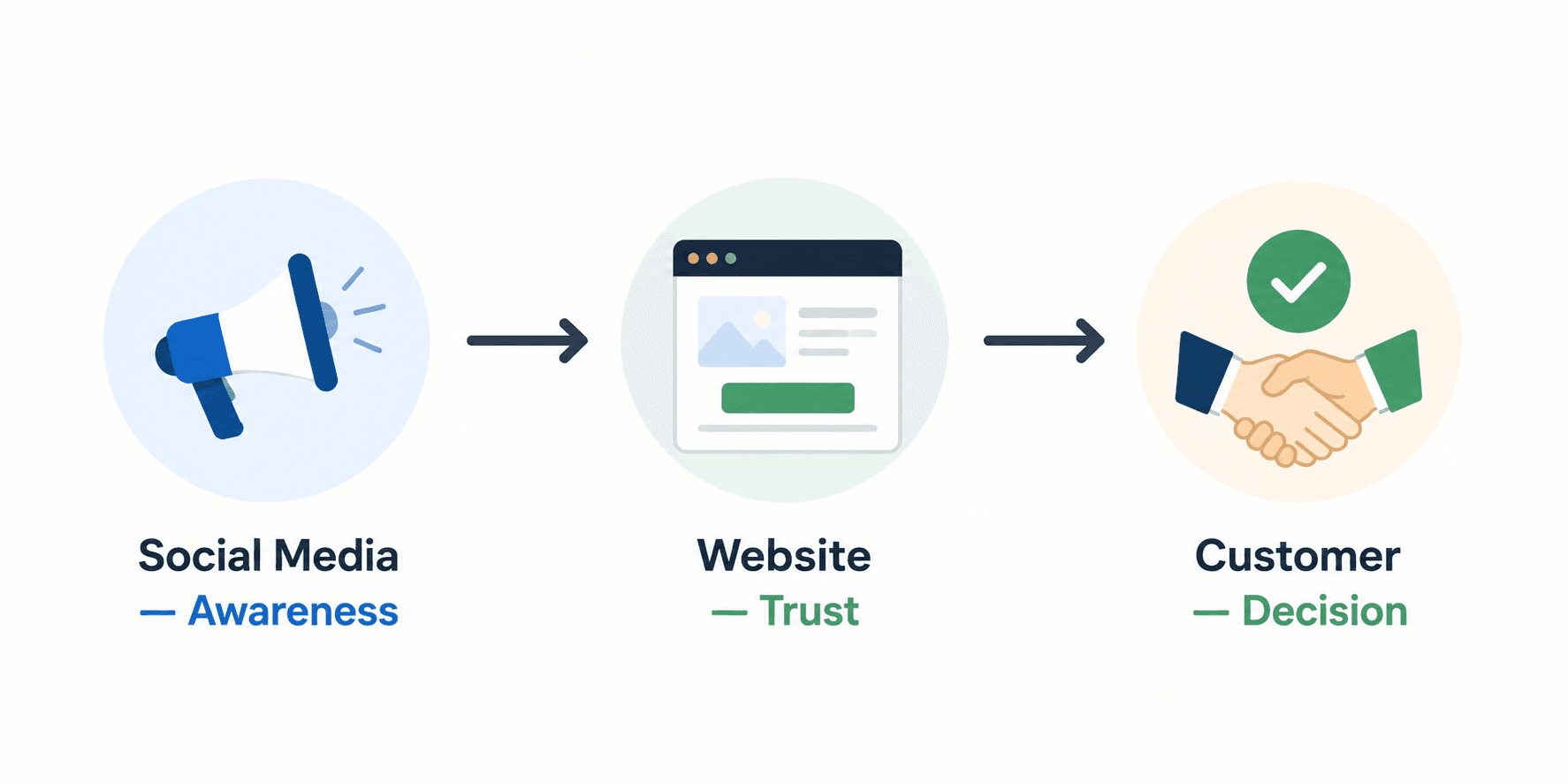
This was never really an either-or decision, and treating it like one is where most of the confusion comes from. Social media and your website do two different jobs in the same customer journey:
- Social media builds awareness. It's where people discover you, see your work, and start following along.
- Your website builds trust and drives the decision. It's where that same person goes to actually understand you before committing to anything.
Think of it as a handoff: your reel gets someone curious enough to tap the link in your bio. What they find there decides whether that curiosity turns into a customer, or just another follow that never turns into revenue.
This is also where a lot of businesses leave money on the table. Getting attention through social media and then sending it to an outdated or unclear bio-link page is a bit like running an ad campaign and pointing it at a blank wall. A website built with search visibility in mind means that same effort keeps working for you — the same audience can find you again later through Google, without you having to post a single time.
We've seen this pattern directly in projects we've built for founders who assumed social media alone was "enough" — right up until a properly structured website started converting that same audience noticeably better, simply because visitors could finally get a clear answer to those three questions within five seconds.
"But Won't a Website Cost Time and Money I Don't Have?"
This is usually the real objection hiding underneath the others — and it's a fair one. But it's based on an outdated idea of what building a website involves.
You don't need a twenty-page site with every feature imaginable to start. A focused, single homepage that clearly explains what you do, who it's for, and what to do next can be built quickly, and it will already outperform a bio-link page or a scattered social presence. You can always expand it — add a shop, a blog, a booking system — as your business grows into needing one.
The real cost isn't building a website. It's the customers you lose every week to a five-second decision you never got the chance to influence.
So, Do You Need a Website in 2026?
If your only goal is to keep reaching people who already know and trust you, you can probably get by without one a little longer.
But if your goal is to grow — to be found by people searching for exactly what you do, to look as credible as the work you actually produce, and to stop losing potential customers because your Instagram bio couldn't explain your business fast enough — then yes, you need one. Not instead of social media. Alongside it.
A website isn't a replacement for your social presence. It's the place that turns the attention social media earns you into something you can actually rely on.
Not Sure What Your Website Should Say?
This is usually where founders get stuck — not on design, but on message. What should the homepage actually say? Who is it really talking to? What's the one action you want a first-time visitor to take?
If you're unsure where to start, Tecorbitron can help you figure out exactly that, and build a website around it. Reach out, and let's figure out what your website should actually say.
Written by

Sagar Chauhan
Director, Founder & CEO