How Much Does It Cost to Build a Mobile App in India in 2026?
Back
Mobile app development cost in India in 2026 can start from a basic MVP budget and go all the way to enterprise-level investment depending on features, platform scope, UI/UX depth, integrations, security, and team structure. This guide breaks down the real pricing ranges, hidden costs, and the smartest way to budget before you hire a freelancer, agency, or in-house team.
One of the most common questions founders ask before starting a product is simple: how much does it cost to build a mobile app in India in 2026? The honest answer is that app pricing depends on scope, complexity, platform choice, design quality, and the team you hire. If you understand those variables early, you can avoid overpaying, underbuilding, or getting stuck in repeated revisions.
In 2026, mobile app development cost in India can start from roughly ₹1,50,000 for a very simple app and go beyond ₹40,00,000 or even much higher for large, custom, enterprise-grade products. For most serious business apps, the real budget usually sits somewhere between ₹4,00,000 and ₹15,00,000, depending on whether you are building an MVP, a business tool, or a scale-ready platform.
Founder reality check: the cheapest app quote is rarely the best deal. An app that looks inexpensive upfront but fails in performance, user experience, or scalability becomes far more expensive later.
What Actually Changes the App Cost?
The first and biggest factor is app complexity. A simple app with a login flow, a few screens, and basic functionality costs much less than an app with role-based dashboards, live tracking, chat, payments, automation, and third-party integrations. Every extra workflow adds design, development, and testing time.
Platform choice also affects the budget. A single-platform app is usually cheaper than building for both iOS and Android. Cross-platform frameworks can reduce initial cost, but the final choice should depend on your users, product goals, and performance expectations rather than just upfront savings.
Design and user experience matter more than many founders expect. A polished interface, clean navigation, and thoughtful onboarding increase user retention, but they also increase effort during the product planning and UI phase. If your app is customer-facing, better design usually pays back through stronger adoption and lower churn.
Backend logic is another major cost driver. The more your app depends on databases, user roles, custom dashboards, APIs, notifications, analytics, booking systems, or admin panels, the more engineering effort it needs. Lightweight apps are faster to build, but apps with real business logic need proper architecture from the beginning.
Security, testing, and app store preparation are also part of the real cost. Many businesses only think about app screens, but a reliable product also needs QA cycles, bug fixes, performance testing, version updates, and launch support. If the app handles sensitive user data or payments, the budget must account for stronger protection and compliance-ready development.
Realistic Budget Bands for India
A very simple MVP or prototype typically falls in the range of ₹1,50,000 to ₹4,00,000. This works when you want to validate an idea quickly, prove market demand, or launch a basic version with limited features.
A standard business app usually costs between ₹4,00,000 and ₹10,00,000. This category is common for service apps, internal tools, customer portals, booking apps, and early-stage startup products that need a professional experience without enterprise-level complexity.
A more advanced product can cost anywhere from ₹10,00,000 to ₹40,00,000. These apps usually include deeper logic, better design systems, multiple modules, stronger admin control, and more custom integrations.
Enterprise-grade mobile apps or large platform ecosystems often start at ₹40,00,000+ and may continue growing depending on roadmap, compliance, infrastructure, and long-term support. These are not just apps — they are product systems with multiple moving parts.

Freelancer vs Agency vs In-House Team
How you hire changes the cost structure as much as the feature list does. A freelancer may be the cheapest option, but pricing can be inconsistent and support after launch is often limited. That can be fine for very small projects, but it is risky when the app is meant to become a serious business asset.
A digital agency usually costs more, but it gives you product thinking, design consistency, development discipline, and accountability. For founders, this often becomes the strongest middle ground because you get a team without the burden of building one internally.
An in-house team offers control and long-term continuity, but it is the most expensive route because salaries, hiring delays, management overhead, and retention all add up. This model only makes sense when product development is a core ongoing function of the company.
Practical advice: if you are a startup or growing business, use a capable agency when you need speed, clarity, and fewer execution risks. That usually delivers better value than chasing the lowest quote.
Hidden Costs Most Founders Forget
The development quote is only part of the total app budget. Many founders are surprised later by costs that were not discussed early, such as design revisions, third-party APIs, hosting, maintenance, testing, app store approvals, analytics, and future updates.
- •Product discovery and planning can save expensive mistakes later.
- •UI/UX design often deserves its own budget line.
- •Backend hosting, databases, and cloud infrastructure can grow with usage.
- •Maintenance is not optional if you want the app to stay stable and secure.
- •App store submissions and compliance work can add time and cost.
If your app includes payments, login systems, live notifications, geolocation, messaging, or AI features, you should plan for these hidden costs from day one instead of treating them as small extras.
How Should You Budget by Stage?
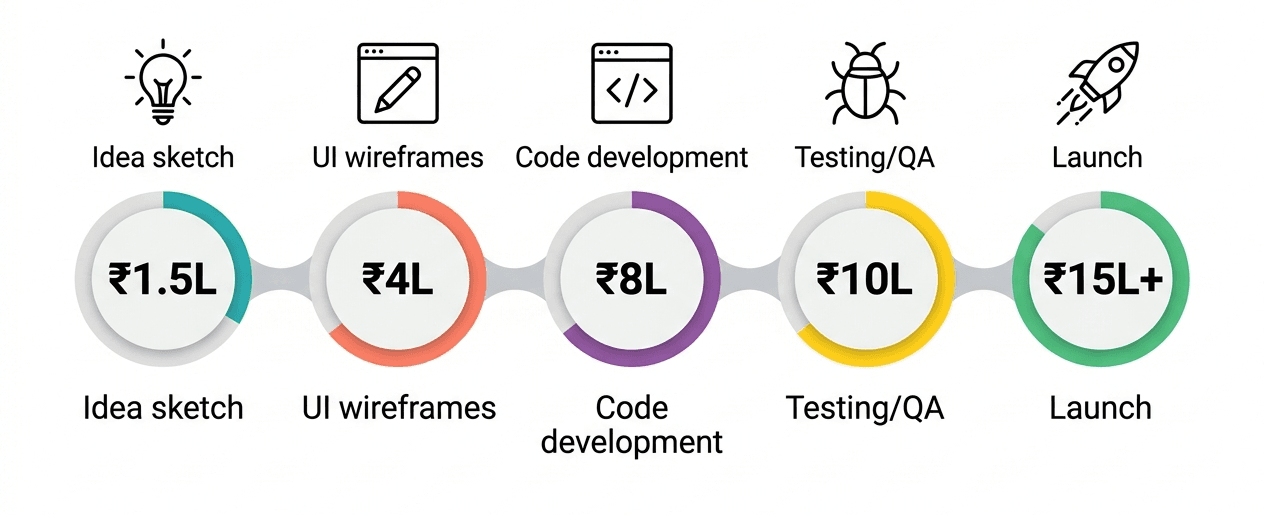
If you are still validating an idea, keep the first version lean. A budget around ₹1,50,000 to ₹4,00,000 can help you build a simple MVP and test demand without overcommitting.
If you are building an early revenue product, aim for ₹4,00,000 to ₹10,00,000. That gives enough room for better design, multiple screens, clean architecture, and a more reliable launch.
If you are scaling a product or serving active users, a budget in the range of ₹10,00,000 to ₹40,00,000+ is more realistic because you are no longer just building screens — you are supporting growth, usage, and business operations.
Final Thoughts
Mobile app development cost in India in 2026 varies widely, but the right budget depends on the business outcome you want. A good app is not the one with the cheapest build price — it is the one that launches with clarity, works reliably, and can grow without a painful rebuild.
Before you hire anyone, compare a few options, ask what is included in the proposal, and make sure scope, design, QA, support, and launch expectations are clearly defined. The earlier you do that, the fewer surprises you will face later.
At Tecorbitron, we build practical mobile solutions for founders, startups, and growing businesses who want clarity, quality, and transparent execution. If you are planning an app in 2026, you can explore our services or contact us for a direct conversation.
Related Articles

Why Your Business Needs a Modern Website in 2026

Agency vs Freelancer vs In-House: Which Development Model Actually Wins in 2026?