Agency vs Freelancer vs In-House: Which Development Model Actually Wins in 2026?
Back
Choosing between a freelancer, an agency, or an in-house team for your next web or app project? Here's an honest breakdown of cost, speed, communication, and risk for each model — and why an agency is the best-fit choice for most businesses building something that needs to last.
Every founder building a website, app, or platform eventually hits the same wall: who actually builds it? A freelancer on Upwork? An in-house team you hire and manage yourself? Or a development agency that handles the whole thing end-to-end?
The answer changes your budget, your timeline, and — more importantly — whether your project actually survives past launch. This isn't a "one is good, one is bad" comparison. Each model solves a different problem. But once you look at cost, speed, communication, and long-term risk side by side, one model consistently comes out ahead for anything beyond a quick, throwaway task.
Let's break it down honestly — freelancer vs agency vs in-house — using real cost and delivery patterns from 2026.
What Each Model Actually Means
Before comparing numbers, here's the quick version of what you're actually choosing between:
- •Freelancer: One independent developer you hire directly for a specific task or short project.
- •Agency: A company with a built-in team — developers, designers, project managers, QA — that delivers your project end-to-end.
- •In-house team: Full-time employees you hire, train, and manage as part of your own company.
Freelancers: Fast to Start, Hard to Scale
Freelancers win on one thing immediately — getting started cheap and fast. For a small, well-defined task like a landing page or a quick fix, that's genuinely the right call.
But the moment your project grows beyond a single clear deliverable, the cracks show up:
- •No real team behind them. One person means one skill set. If your project needs frontend, backend, QA, and design together, a solo freelancer is stretched thin or simply doesn't have it.
- •Communication gaps. No structured process, no project manager — updates happen when the freelancer has time, not on a schedule you control.
- •Limited capacity. Freelancers are typically capped around 20–40 billable hours a week. There's no way to "add more hands" quickly when the scope grows.
- •Bus-factor of one. If they go unavailable, get busy with another client, or leave mid-project, you're stuck. There's no backup, and the knowledge of your project walks out with them.
- •Hard to build scalable systems. A freelancer can ship a feature. Architecting something that scales cleanly as your user base grows is a different skill — and usually needs more than one person reviewing the decisions.
Freelancers are ideal for fast MVPs, small fixes, or specific one-off tasks — not for products you plan to grow for years.

Agencies: The Balanced, Built-for-Growth Option
An agency costs a bit more than a freelancer upfront — but what you're actually paying for is a system, not just code. At Tecorbitron, that system is the whole point.
Here's what that extra investment actually buys you:
- •Built around what the client wants. Requirements are gathered properly upfront and the build is shaped around your goals — not a generic template stretched to fit.
- •Proper communication systems. Dedicated points of contact, scheduled updates, and project tracking — you always know where things stand.
- •Legal clarity. Contracts, scope documents, and IP ownership terms are handled properly between the client and the agency, protecting both sides.
- •On-time delivery. A managed team with defined roles (PM, developers, QA) keeps projects on schedule the way one person juggling everything can't.
- •Systems built to last. Platforms, websites, and apps are built with maintainability and future scaling in mind — not just to "work for now."
- •Proper documentation. Code, architecture, and processes are documented, so the project doesn't become unmanageable the moment someone new touches it.
- •Lower risk. Working with a registered, compliant private limited company means accountability — there's a real legal entity behind the work, ready to handle disputes professionally if they ever arise.
This is also why agencies scale faster mid-project than freelancers can. Need to speed up before a launch deadline? An agency can add a developer to the sprint within days using processes that already exist. A freelancer either burns out trying to do more, or you're suddenly managing a second person yourself.

In-House Teams: Maximum Control, Maximum Cost
Building an internal team gives you the most direct control — but that control comes at a real price, and not just the salary line.
- •Higher overall cost. A fully-loaded in-house developer typically costs 30-60% more than the base salary once you add benefits, infrastructure, recruitment, and management overhead.
- •Recruitment and onboarding take time. Hiring alone can take 1-3 months, and a new developer usually needs several more months before reaching full productivity.
- •No guaranteed timeline. Unlike an agency with established processes, an in-house team's delivery speed depends entirely on how well you can manage and coordinate them yourself.
- •No guarantee they'll deliver your vision. Hiring skilled people doesn't automatically mean alignment — you're now responsible for direction, review, and quality control too.
- •Turnover risk. If a key developer leaves mid-project, you're back to recruiting — and the new hire needs time just to understand the existing codebase before they can contribute meaningfully.
- •Infrastructure cost on top of salary. Tools, licenses, and equipment for an in-house team add to the bill regardless of project size.
In-house teams make sense when software is your core, ongoing business and you need deep institutional knowledge that compounds over years. For a single project — a website, an app, a platform — it's usually the slowest and most expensive way to get there.
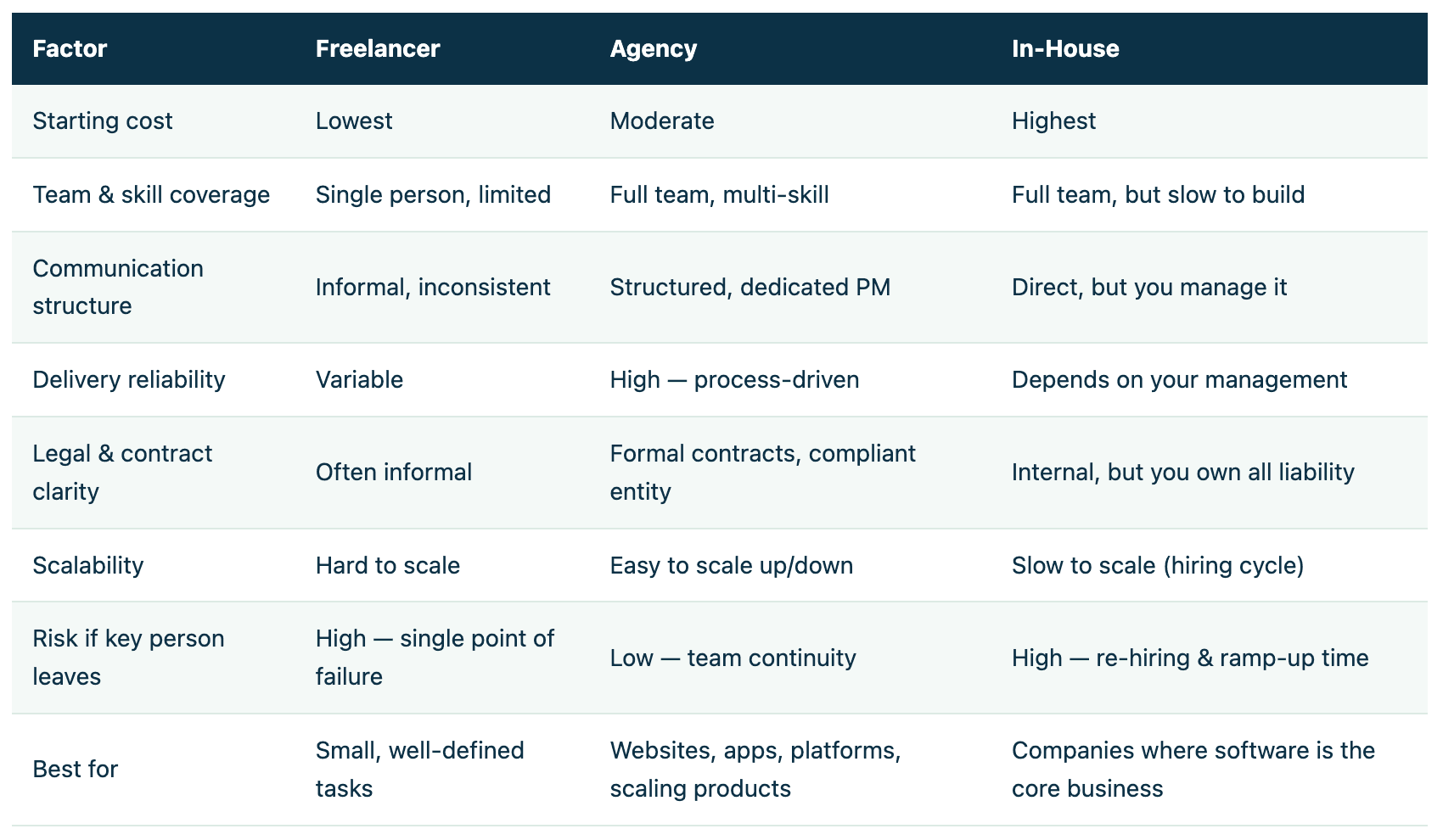
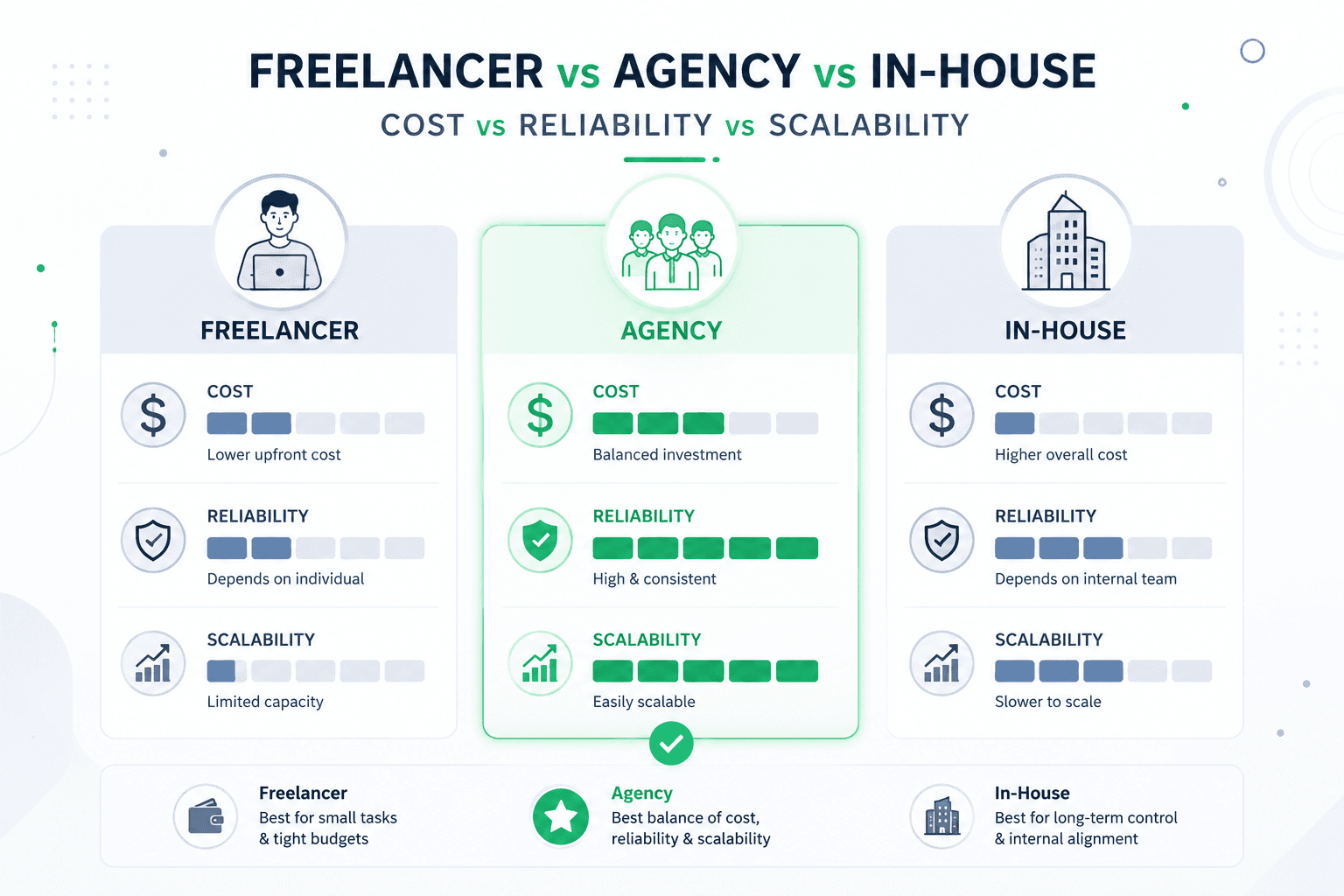
Side-by-Side: Freelancer vs Agency vs In-House
Which Model Should You Actually Choose?
Here's a practical way to think about it:
- •Need a quick fix, a single small task, or have in-house technical leadership to manage someone directly? A freelancer can work fine.
- •Building a website, app, platform, internal system, or anything meant to scale and last? An agency is built for exactly this.
- •Is software your actual core, long-term business, with budget and patience to build a team over years? In-house can pay off eventually.
Most founders building a product, not just a feature, land in the second category — and that's exactly where an agency's structure, accountability, and process pay for themselves.
Conclusion: There's No One-Size-Fits-All — But There's a Clear Best Fit
There's no single right answer for every business. The right model depends on your goals, your budget, and your growth stage — a quick landing page doesn't need the same setup as an enterprise platform.
That said, when you're building anything that matters long-term — a website, an app, a platform, a system, or enterprise-scale software — an agency consistently comes out ahead across cost-efficiency, delivery reliability, communication, legal safety, and scalability. You get a full team without the hiring cycle, a structured process without the management burden, and a compliant, accountable partner without the legal exposure of going solo with a freelancer.
If you're trying to figure out which model fits your specific project, that's exactly the conversation worth having before you commit a budget.
🚀Ready to build it right the first time? Explore our services or get in touch — we'll help you figure out the right approach for your project, no generic pitch, just a clear plan.
Related Articles

How Much Does It Cost to Build a Mobile App in India in 2026?

Why Your Business Needs a Modern Website in 2026